Monday, April 18, 2011

AND YOU THOUGHT THEY WERE JUST FOSSILIZED BONES

Most people see the great wall of dinosaur bones at the Monument as what it is: a great wall of dinosaur bones. However, some see our fossils in other ways. I once had a crank tell me that the bones had been placed in the sandstone by Satan to deceive us. However, here I am more interested in writing about how some artists look at fossils, especially those at and from Dinosaur.


Allan McCollum is a contemporary American artist who has been “exploring how objects achieve public and personal meaning in a world constituted in mass production, focusing most recently on collaborations with small community historical society museums in different parts of the world.” (1) He has been exploring exhibits using replicas, both natural and man-made, of various sorts for a number of years. However, here we’ll just look at his project Lost Objects which involves fossils from Dinosaur National Monument.

McCollum was involved in a project at the Carnegie Museum of Art when he became aware that the art museum was affiliated with the Carnegie Museum of Natural History. The latter houses one of the great collections of dinosaur bones and so the artist approached the museum with an idea he had been thinking about for some time, a project that became Lost Objects.


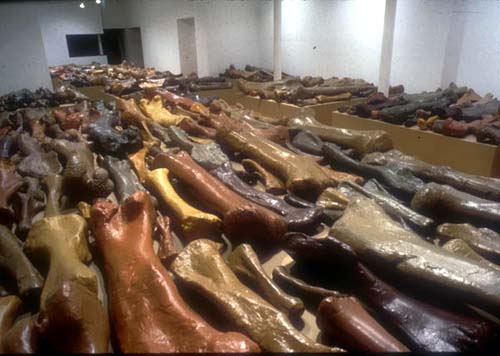
Lost Objects is an exhibit involving 750 replicas of 15 original sauropod bones in the Carnegie’s collection (technically enamel paint on glass fiber-reinforced concrete). The exact locality for all 15 originals is not known to me, but many, if not all, of them came from the Carnegie Quarry at Dinosaur. These 750 replicas were painted a variety of earth colors that could conceivably be seen in real dinosaur bones. No bright primary colors!


Actually, the exhibit is similar to how one might find collections of large sauropod bones in the non-public museum collection storage areas. Given that a large sauropod femur can weight 500 pounds or more, such a storage approach would make them easy to study and photograph. For those who care, the casts in the photos are from both adult and juveniles sauropods and include humeri, radii, ulnae, femora, tibiae, and fibulae. At least some of them are from Camarasaurus.


The casts were laid out in groups on bases. As recounted by the art critic and historian W.J.T. Mitchell “The installation of these bones in the neoclassical atrium of the Carnegie Museum is … an uncanny resurrection of Thomas Jefferson’s lost ‘bone room’ in the East Wing of the White House, as if we were privileged to go back in time and see the mastodon bones replaced by their cultural descendants, the dinosaur.” (5 p.270).


What is the artist exploring with such exhibits? McCollum talks about fossils as symbols of enormous absence and loss and how what we produce and collect displaces our fears of death, etc. I’m not about to try and explain what the artist is communicating through his work, that is best understood by reading what  McCollum himself has to say in interviews in print and on video (2, 3) and at his website (4). Mitchell (5 p.269) writes that “Traditional notions of the relation of copy and original, not to mention the status of the artists ‘authorial’ function are clearly under considerable pressure in these works…” I guess I see that.


A Note on Sources

For this blog I have drawn heavily on the chapter entitled Coda: PaleoArt in Mitchell 1998. A reader interested in exploring the artistic themes of Lost Objects  and dinosaurs in modern art would do well to read that chapter in full.

REFERENCES
(1) http://en.wikipedia.org/wiki/Allan_McCollum

(2) http://www.allanmccollum.net/allanmcnyc/Lynne_Cooke_Carnegie.html Excerpts from an interview with Allan McCollum by Lynne Cooke, curator at large for the Dia Art Foundation in New York, and chief curator at the Museo Reina Sofia, Madrid, Spain

(3) http://www.artbabble.org/video/art21/allan-mccollum-lost-objects-natural-copies A 4 minute video interview with McCollum. Although he talks mostly about Natural Copies, an earlier fossil exhibit involving dinosaur footprints from coal mines in Price, Utah, those concepts and ideas also lie behind Lost Objects.

(4) Allan McCollum’s website: http://www.allanmccollum.net/allanmcnyc/

(5) Mitchell, W.J.T. 1998. The Last Dinosaur Book. The life and times of a cultural icon. University of Chicago Press, Chicago: 321 pp.


Photo Credits
Lost Objects
http://blog.art21.org/category/artists/allan-mccollum/ 
http://www.artnet.com/Magazine/features/finch/Images/finch5-8-2.jpg
http://m2museologie.files.wordpress.com/2010/09/cliche-2010-10-12-19-06-57.jpg


Allan McCollum http://unrealnature.files.wordpress.com/2010/07/mccollum_allan.jpg

Friday, April 15, 2011

ALUMINUM, RUBBER, SILICA, AND A TOUCH OF PAINT


Currently the major effort at the QVC is getting the glass into all the walls of the building. Once enclosed and secured the plywood sarcophagus and aluminum scaffolding can be taken down.


Work is starting on the north wall, will progress down the east and west sides, and the south wall windows will be the last installed. Before starting this, all structural beams were painted. The minimum temperature for painting is 50oF on the beam surface. While that can be reached in sunlight on most walls, the north wall does not get direct sun. So, just as with the curing of the cement south wall during the winter cold snap, the north wall beams were enclosed in blankets and propane heaters used to keep the temperature up during painting.


All the supplies for the window project are stored in the QVC parking lot and lifted by crane up to behind the north wall. There pieces are cut to size.


Individual panes of glass are about 3 feet by 3 feet, smaller than the large spaces between the structural beams. So the first step is to install vertical window frames between the structural beams.


Next, the horizontal window frames are put in.


Then the rubber baskets for each window frame is set into the aluminum frames.


 Once this is completed for the entire north wall, then the new glass, which is more energy efficient thanthe old plexiglass, will be lifted to the north side and installed. Work will then proceed to the other walls. Given the vast expanse of glass in the QVC walls, it will take about a month to get all the windows in.


While the ceiling inside the QVC will be white, the eaves outside the building are being painted a light sandstone brown and the vertical structural beams will retain their original chocolate brown.


 Given the height of the building, the eaves and the beams are painted from the crane basket.

Photos: NPS

Wednesday, April 6, 2011

GOODBYE DESERT ROSE

We have completed the installation of the steel for the north side, exterior ramp, mezzanine, interior ramp, east wall, west wall, and south wall. Some of the steel is new, some of it is recycled from the previous QVC walls, and much of it has been left in-place throughout the project. Priming and painting has already started on the eaves and the ceiling inside the building. The north wall was tented and heated while the primer coat was applied. Hopefully warmer temperatures will arrive and tenting will no longer be needed. One would hardly think that the painting of beams and ceiling would be the reason for employee celebration, but for those of us who worked in the old QVC this is momentous. 

The north wall and adjacent ceiling then ...

... and now.


In 1986 the old QVC was listed as one of the properties in the National Register as part of the Dinosaur National Monument Multiple Resources Listing. In January of 2001 the QVC was specifically listed in the National Register as a National Historic Landmark. The latter listing is especially important because it cites the time period 1957-1958 as the “period of significance” for the building. During that time the structure was constructed and first opened to the public. As a result, the recommendations laid out in the Dinosaur Historic Structure Report Quarry Visitor Center(1) relied heavily on the original design as “the look” that needed to be preserved:

“Known alterations, implemented after the period of significance, are recommended to be removed. Conversely, known historic … design features are recommended to be restored to, or retained at, their historic 1958 appearance. With that in mind, this report recommends restoring the structure to its initially-constructed appearance, the only variance from the original design being accessibility, egress, and structural treatments.”

These directives caused all kinds of problems, but for the present let’s look at the seemingly insignificant issue of paint colors. As described by Allaback (2, p: 51):


"The "finish and color schedule" for the visitor center paints a colorful picture of the building's original interior surfaces. The visitor gallery walls and trim were surf green and the ceiling vernal green. The lobby was surf green with varnished birch trim, and the rotunda and stairway were also green. Offices had walls painted starlight blue and honey beige. Less significant spaces, such as corridors, vestibules, and storage spaces, were tusk ivory. These brightly painted surfaces were intended to relieve the monotony of the valley's gray surroundings and, perhaps, create the effect of an oasis in the desert."

Oddly, this “oasis imagery” was lost on most employees. I remember the faded blue and puke surf green when I came to Dinosaur in 1979. I assumed they were the result of poorly thought out painting schemes and nothing more than a hodgepodge of crappy colors. Over the years, walls were covered with shelves for books, specimens, and storage. Walls were replaced, removed, or installed. Eventually many of these colors were replaced with white or some variant of that.


A stand of majestic desert rose beams on the east wall of the QVC support the vast expanse of desert rose ceiling and eaves.
Who would dare go Behind the Pink Door?
So after the QVC was listed as a National Historic Landmark in 2001, movement started to return to the original “oasis” color pattern. The worst result of this was the painting of many of the beams of the QVC and the ceiling of the exhibit area over the cliff face a pink color. The preservationists told us this was actually a color properly described as “desert rose” but nearly everyone at the Monument simply rolled their eyes and referred to as “that pink”. It was, quite simply, pretty awful. Many of the photos in past blogs show the remarkable expanses of “desert rose” in the old QVC.


With the destruction and removal of the rotunda and administrative wing, it is no longer possible to retain the 1957-1958 appearance and, thankfully, we are liberated from the oasis diktat. Sane colors will be part of the new interior, allowing the visitor to focus on the quarry face without being distracted by an immense framework of glaring pink beams and window frames. So the simple act of priming and painting in the QVC is more momentous that one might think.


Honestly, does this look "gray and monotonous" to you?

While I’m ranting, I’ll also take exception to the above cited statement that “These brightly painted surfaces were intended to relieve the monotony of the valley's gray surroundings and, perhaps, create the effect of an oasis in the desert.” When I look around at the landscape surrounding the QVC, I see the golden buff Navajo Sandstone, the intense brick red of the Carmel Formation, both the brown and golden river sandstones of the Morrison Formation, the variegated maroon and grey banded mudstones in the Morrison and Cedar Mountain formations, and the shimmering silver of the Mowry Shale, to name just a few. So the landscape is hardly gray and monotonous. I guess some people just can’t see that. Then again, the old ramp leading into the second floor of the rotunda was supposed to be an architectural element reminiscent of the tail of a sauropod dinosaur, one of the common residents of the Carnegie Quarry. Funny, I thought it was simply a ramp to get people into the building – what an ignorati.

Practitioners of the dubious science of color psychology claim that the color pink has a calming effect (3). However, this is apparently only and initial reaction, because when used in prison, inmates often become more aggressive as they become accustomed to the color (3, 4). While employees at Dinosaur didn’t become more aggressive with exposure to pink….er “desert rose”, one of the long term effects of exposure is that we tended to look down at our feet rather that looking at anything above shoulder height.

Amusingly enough, the belief in the calming effects of pink has also been used in college athletics. As recounted at one website (4):

“University of Hawaii associate head coach George Lumkin was a member of the 1991 staff that saw visitor locker rooms at Iowa and Colorado State painted pink in the belief that the color made players passive. Now the WAC has a rule that a visiting team's locker room can not be painted a different color than the home team's. In other words, it can be pink, black or any color of the rainbow, as long as both locker rooms are the same color.”

References
(1)Dinosaur Historic Structure Report Quarry Visitor Center http://www.nps.gov/history/history/online_books/dino/hsrt.htm

(2) Allaback, S. 2000. Chapter 1. Quarry Visitor Center, Dinosaur National Monument, Jensen, Utah. in: Mission 66 Visitor Centers: The History of a Building Type. United States Department of the Interior, National Park Service, Cultural Resource Stewardship and Partnerships, Park Historic Structures and Cultural Landscapes Program, Washington, D.C.: pp. 39-66. http://www.nps.gov/history/history/online_books/allaback/vc1.htm

(3) http://psychology.about.com/od/sensationandperception/a/color_pink.htm

(4) http://www.colormatters.com/body_pink.html

Photos: NPS

Friday, April 1, 2011

EARLY MORNING EARTHQUAKE DAMAGES QUARRY VISITOR CENTER AND DINOSAUR BONES

At 4:47 AM Mountain Standard Time a 2.8 magnitude earthquake occurred in northeastern Utah. While not  a powerful quake, the epicenter was shallow and only 4 miles south of Dinosaur National Monument. Two of the I-beams beams in the center of the north wall of the QVC failed and dropped onto the quarry face. About 40 percent of the roof and three roof I-beams also fell onto the quarry. Because it was before the start of the work day there were, thankfully, no injuries. However, with light of day preliminary examination of the quarry shows extensive damage to fossils, many of which probably cannot be repaired. April Fools!

Thursday, March 31, 2011

A DINOSAURIAN DÍA DE LOS MUERTOS

June 1, 1958. Utah Governor George Dewey Clyde (right) cuts a ribbon to officially open the new Quarry Visitor Center at Dinosaur National Monument. Also in attendance: Roger C. Ernest (center), Assistant Secretary of the Interior from Washington, D.C., and Oscar Dick (left), Chief Ranger for the Monument.

October 4, 2011 has been set for the grand re-opening of the two new Visitor Centers at Dinosaur National Monument. For the first time in five years the public will again be able to gaze upon the spectacular wall of Jurassic dinosaur bones and wander among exhibits that tell the story of the Carnegie Quarry and the Morrison ecosystem in the Monument.

Why an opening date in October, after the summer visitor season? Well it would be nice to open at the beginning of the visitor season but we couldn’t start construction until funding was available and that only became available in late winter 2009/2010. Construction started as soon as possible after that, but the project of extensive and complicated rehabilitation of two visitor centers just takes time --- close to 18 months in fact. Once the NPS takes possession of the buildings there is additional work that needs to be done, such as moving in and installing completely new exhibits, final cleaning of the quarry face and its bones, etc. Everyone, the government, contractors, subcontractors, etc., has worked as hard as possible to get this project done as soon as possible. It just couldn’t be done any faster.


Given that everything will be ready in October, the 4th was selected as the specific opening day because Dinosaur National Monument was established on October 4, 1915 by Woodrow Wilson (Presidential Proclamation Number 1313) to preserve “... an extraordinary deposit of Dinosaurian and other gigantic reptilian remains of the Juratrias period, which are of great scientific interest and value...”. The original reservation consisted of just 80 acres, including the Carnegie Quarry.


So October 4 is certainly an important day in the history of Dinosaur National Monument. But other significant events have occurred on this day, the more notable of which are

1209 Pope Innocent II crowns German king Otto of Wittelsbach.

1675 Christian Huygens patents the pocket watch.

1877 Pancho Villa, Mexican revolutionary is born.

1904 First day of New York City subway, with 350,000 people riding 9.1 miles of track.

1905 Henry Fairfield Osborn names and describes Tyrannosaurus rex in a scientific publication.

1911 The first public elevator goes into operation at London's Earl's Court Metro Station.

1949 United Nations' permanent New York City headquarters is dedicated.

1957 The Soviet Union launches Sputnik I, the first artificial satellite to orbit the Earth.

1957 Leave It to Beaver premieres on ABC-TV.

1970 Herbert Schmidtz makes highest parachute jump from a tower by leaping from a 1,984 ft tall TV mast in Tulsa, Oklahoma.

1994. The film Jurassic Park is released to home video.

1997 The auction of the T. rex specimen known as “Sue” is held. Opening bids start at $500,000 and less than ten minutes later, the Field Museum had purchased the remains with the highest bid of $8,362,500.


In ancient Rome October 4 was also the day of the Ieiunium Cereris, a day of fasting to honor Ceres a goddess of agriculture, grain crops, fertility and motherly relationships. It’s unfortunate that Woodrow Wilson wasn’t a little quicker with the signature pen and instead created Dinosaur National Monument on October 3, because that day, in ancient Rome, was the Festival of Bacchus, a celebration to thank the god for the year's harvest of grapes for wine making! Many of the world’s top sommeliers recommend a dry but rounded Sauvignon Blanc and Semillon mix (such as a Hardys Stamp of Australia Sauvignon Blanc Semillon 2002-2003) as an excellent pairing with roasted Allosaurus because, you guessed it, it tastes like chicken!

"Thanks for the refill.  Would you be a dear and please get me another bucket of those Allosaurus nuggets? Oh, and by the way, what time is the ribbon cutting?"


A final thought. The fiscal year for the Federal Government starts on October 1. Let’s hope that Congress has funded the government by October 1 because without an authorized budget, the government will close be forced to close down. Wouldn’t it be ironic, to finally have the building completely repaired, the exhibits installed, the quarry cleaned, celebrations in place, all ready to welcome the public back, and we are forced to keep the building closed? It would bring a tear to an allosaur’s eye.


Photos

1958 dedication: Uintah County Library.
Woodrow Wilson Stamp: US Postal Service
Bacchanalia: http://classicsclubutsa.blogspot.com/2010/11/beer-lubricated-rise-of-civilization.html

Sunday, March 27, 2011

AREN’T YOU A BIT OLD FOR BRACES?

As I mentioned a few posts back, new measurements and subsequent re-evaluation suggested that the beams on the north side of the Quarry Visitor Center were not vertical and were in need of additional strengthening. Well that project is now completed and here are the results.


With the exception of the end beams, each beam along the north wall was reinforced --- eight in all. Surprisingly, of the many photos I have of the QVC and this project, none show much detail of the north wall beams before repairs. So we’ll have to make due with a recent photo which I have photo shopped to remove the corrections. Each vertical I-beam is welded to a long roof beam that slopes strongly to the south. Given the southward pull exerted on the vertical beam by the roof and the movement of the vertical beams over the years, the engineers were concerned about the ability of the vertical beams to resisted deformation.


Thick steel plating was welded to the back side of each beam for its entire height.


Similarly, thick steel plating was welded to the front of each beam for its entire height.


To resist failure at the juncture with the roof beam, a wedge of steel plating was welded onto the front of the vertical beam and the underside of the roof beam. This was further strengthened by addition plates (fins) that were welded edge on, adjacent to the wedge, along the side of both beams. Looking closely one can see where paint has been removed prior to welding. Remember, the old QVC paint has a high lead content and the heat of welding would vaporize the paint, creating a mix hazardous to breath in.

Built in 1958, the steel armature of the original QVC is now nearly 53 years old. Over that time uplift, down drop, and twisting have made the current repairs necessary, especially if the building and steel is to last another half century. A person getting braces at 53 years of age is pretty rare. Less so for steel beams.

However, we can look at this another way. The iron atoms that makes up the bulk of the steel beam were one of the original constituents of the earth. The age of the earth is about 4.54 billion years old, so these iron minerals are at least that old. However, iron, like all elements other than hydrogen, are made in the fusion engines in the cores of stars. The rate of such element formation is understood to the extent that we know that given its age, the Sun has more iron than it could have produced solely through fusion. What this means is that our sun and solar system must have formed from the remnants of a previous star that went supernova. Those supernova remnants contained abundant iron atoms and eventually condensed to form the Sun and its planets. Given that the universe is 13.75 billion years old, the iron in our QVC beams might have passed through several star lifetimes since it was formed. The same is true for the iron and other elements in our bodies --- the “star stuff” of Carl Sagan.

But I digress. It isn’t the age of the iron atoms that present the failure threat in the beams in the QVC. That’s an issue of engineering and those damn expanding Late Jurassic bentonitic mudstones.

Photos: NPS

Friday, March 25, 2011

ALL POINTS BULLETIN: LUCILLE BALL (aka TRACY COLLINI) WANTED FOR THEFT OF GEOLOGICAL SPECIMENS FROM DINOSAUR NATIONAL MONUMENT AND TRANSPORTATING THEM ACROSS STATE LINES: APPROACH WITH CAUTION!


 In the 1954 hit comedy film The Long, Long Trailer (1), newlyweds Nicki Collini (Desi Arnaz) and Tracy Collini (Lucille Ball) want to save money to purchase a house. So they buy a new (1953) 40-foot  New Moon trailer and a 125 HP V-8 Mercury Monterey convertible to tow it with and travel around the USA on their honeymoon. As might be guessed, there are misadventures and the trip turns into a series of slapstick disasters. But don’t fret -- everything ends happily with Nicki and Tracy hugging and kissing.


Among their many stops are several National Parks. What is of interest to us, constant reader, is the drive over an 8,000 foot mountain pass. This is a very steep road and although the new and powerful car is capable of the job, Nicki is really concerned that the altitude and the weight of the trailer may prevent him from getting to the top of the mountain. He’s also worried that the car’s breaks may fail coming down from the pass. So he gets prepared the night before in the trailer park.


Nicki takes Tracy back into the trailer, sees numerous large rocks on the floor, and tells her she must get rid of them. He heads to the garage to have the car checked out and the trailer park attendant, Mr. Ludlow (played by Oliver Blake), helps Tracy by carrying the rocks out of the trailer and putting them on the ground.

Watching Mr. Ludlow carrying a block out the trailer door, Tracy suddenly asks “What was the name on that one?” Ludlow reads the label taped to it “Dinosaur National Monument”. “Oh that’s one of my favorites” Tracy moans, “I just can’t let that go. Bring it back in again, please”. With a “Yes, ma’m” Mr. Ludlow obliges her wish.

The block is about 24” x 20” x 10”, light brown in color, and shows several sedimentary levels weathered to various depths. As best I can tell using the freeze command on my DVR, there is no bone on the surface. Given the color and the marked bedding, it does not appear to be a piece of the Carnegie Quarry sandstone. It doesn’t even look like any of the Mesozoic formation here. It most resembles something from the marine Paleozoic Formations, of which there are many in Dinosaur. Of course, there is the outside chance that the block is actually fabricated …….


The next day they head up the pass via the Whitney Portal Road. It is a rough go, with vehicles coming in the other direction, rockfall, precipitous drops, and getting the car’s tries stuck at a turnout. Shortly after making the summit, Nicki stops the car to take a break. While stopped the springs break with a crash on one side of the trailer and it suddenly leans steeply to one side. A suspicious Nicki storms back into the trailer and goes ballistic when he finds large rocks on the floor. Ignoring Tracy’s pleas, Nicki picks the blocks up and, one by one, throws them out the trailer door and over the cliff. One of the first blocks to go airborne is the easily identifiable rock from Dinosaur!

Why did Dinosaur National Monument figure so prominently in this movie? It is not because of a new Quarry Visitor Center --- that was not built until 1958.True, at this time one could visit the Carnegie Quarry and see some test excavations being conducted, but that did not have a high national profile. It is almost certainly related to the great dam controversy swirling around Dinosaur in the early 1950s.

After WWII the US Bureau of Reclamation planned to build a series of hydroelectric dams on the rivers of the western United States. Several of those were scheduled for Dinosaur and one would have flooded the spectacular Echo Park in the middle of the Monument. Echo Park, with its majestic 1000 ft canyon walls is where the Green and Yampa rivers join. Under this plan Echo Park would have been filled with water to a depth of 900 feet!

The Echo Park Dam proposal became the first battle between environmentalists and developers and was a watershed moment for the environmental movement (2). Ultimately, a compromise was reached in 1956 (two years after the movie was released). The Dinosaur dams were dropped from the plans and other sites, such as Glen Canyon, were substituted.

The Echo Park battle made national headlines in the early 1950s and is probably the reason why Dinosaur is in The Long, Long Trailer. I hope Lucy wasn’t so busy stealing rocks from Dinosaur that she didn’t get a chance to see some dinosaur bones while she was here.


References

(1) The Long, Long Trailer was released on DVD on May 2, 2006 by Warner Home Video. It was released as a single disc and as a part of a 3-DVD set featuring two other Ball/Arnaz movies, Forever, Darling and Too Many Girls.

(2) Harvey, M.T. 2000 A Symbol of Wilderness: Echo Park and the American Conservation Movement. University of Washington Press. ISBN 0-295-97932-1.