Saturday, November 12, 2011

HANGING DINOSAURS

Here’s the challenge: how do we make this …

“Differs from other plagiaulacoids in having restricted enamel on both the lower incisors and on I2; differs from all Cimolodonta in having a complete primitive dental formula of 3,1,5,2/1,0,4,2.” (1)

… understandable to the general visiting public coming to Dinosaur to learn about dinosaurs and the world they lived in?

Much of the science of vertebrate paleontology involves detailed morphological description of bones and analysis of evolutionary relationships (the latter assisted by sophisticated computer programs evaluating extensive morphological/taxonomic databases). Inferences about paleobiology can only be based on an understanding of morphology and how the components of an organism function as an integrated whole. So while a visitor may not understand, or even care about, the fact that Glirodon has restricted enamel on its incisors, they might be interested in what this means --- that these ancient diminutive mammals had self-sharpening teeth, as in rodents (even though  they have only a very remote relationship to rodents) and could gnaw on resistant plant material without dulling them. And Glirodon, whose skull is only a one inch long, is known only from the Morrison exposures in Dinosaur and nowhere else.

At Dinosaur we are faced with the further problem of having relatively little exhibit space in the Quarry Exhibit Hall. Filling that limited space up with dense text and complex illustrations of teeth and bones might get the message across to our colleagues but would tend to cause visitors’ eyes to glaze over, especially so with kids. This is further complicated by the fact that the Morrison Formation in the Monument has an exceptionally rich and diverse fossil record ranging from 80 foot dinosaurs to microscopic pollen. So to solve this problem making the scientific mumbo jumbo understandable we turned to the community of paleoartists who specialize in bringing the past back to life.

For our new exhibits we worked with Bob Walters, Tess Kissinger, and their talented staff who have extensive experience in this area, including creating the largest ever mural of a dinosaur community (check out http://www.dinoart.com/ for many examples of their artistry). They have won several prestigious awards for their work. I worked very closely with them in developing the major art piece for the QEH --- an 80 foot long, 9 foot tall , full color reconstruction of the Morrison ecosystem preserved in the rocks of Monument. We decided quite early in the process to try and show as much of the Monument’s Morrison diversity as possible. That was no mean feat given that over 60 species have been found here and most of the diversity is small non-dinosaurian animals, some microscopic. It was quite a challenge and an exciting experience. I’ll talk about the mural in the future. For now I’d like to explain how one installs such a monumental piece of art.

In a way it’s just like hanging wall paper, sort of. The entire mural is printed across numerous sheets and in one run. What that means is that if one sheet is somehow damaged or ruined the entire 80 foot mural needs to be reprinted and rehung. One cannot simply print a single sheet because the colors will be ever so slightly different and it will stand out oddly in the mural. So it’s like hanging wall paper except if something goes wrong the entire thing needs to be redone. I hate hanging wallpaper even more than I hate accordion music.

Luckily, the exhibit installers had considerable experience with this sort of thing. So let’s follow how this is done.

First a new 80 foot x 10 foot wall is installed that is flat and has smooth seams, with no gaps between sheets of drywall.


Each sheet of the mural has an adhesive back that is covered by a removable sheet of paper. Each sheet is long and wide so it it rolled up …


… and lined up with the top of the mural and the previously hung sheet.

The backing is removed near the top and the sheet attached. Then the backing in removed in sections and the entire sheet is placed on the wall.


Wrinkles are a potential problem, so as the backing is removed the mural is rubbed with a soft but somewhat stiff block to make it smooth.


The excess at the bottom is trimmed off.

There are exhibit cases set into the mural so the parts of the mural over those cases is cut away.


When the sheet is done, repeat process until all 80 feet of the mural is installed.


The mural is both a striking piece of art and a scientific tool of great explanatory power. Remember, much of the Morrison’s diversity is small and finding some of the animals in the mural is akin to a 149 million year old Where’s Waldo?
A small, shrew-sized mammal hiding under ferns in the new mural


Photos: NPS

References
(1) Engelmann, G.F. and Callison, G. 1999. Glirodon grandis, a new multituberculate mammal from the Upper Jurassic Morrison Formation. in: Gillette, D.D. (ed.) Vertebrate Paleontology in Utah. Utah Geological Survey, Miscellaneous Publication 99-1: 162-177.

Saturday, October 29, 2011

GENTLY HOLDING THE FAMILY JEWELS

The exhibiting of fossil vertebrates at Dinosaur is somewhat unusual in that in our main display the 1500+ in-situ bones are supported by the conglomeratic sandstone in which they were buried. Although a few areas are friable from increased clay content, much of the sandstone is both hard and strong, which allows bones weighing up to several hundred pounds to be safely exposed in bas-relief.


However, delicate items, even if still in small pieces of rock, present a different challenge. These are displayed in cases and require other support so that they are held securely and in the right place both relative to lighting and explanatory text. These supports are built on site by the exhibit fabricators and installers. Each is built to match the specific size and shape of the fossil it holds.

The fabricators start with a collection of brass rods of varying width, length, and shape.

In most cases, four arms are needed, so short pieces of brass rod are cut and laid across one another at right angles. These are placed on a heat resistant ceramic slab.


Next, a rod is placed vertically and supported upright with a clamp. A small dab of flux is placed at the point where all three rods contact.


Now you can see clear why a ceramic base is needed. A small butane torch and solder is used to firmly join all the pieces together.


The arms that hold the specimen are cut to the correct length and bent to fit around the edges of the fossil. Areas that will directly contact the specimen are cushioned with soft white material or a rubber sleeve.


Once properly formed, the ends are rounded off on a small belt sander.

Then the frame is put in a vise and spray painted a neutral color.


The frame is then attached to the inside of the case……

… and the specimen is placed in it. The small arms are adjusted as needed so that the fossil is firmly held. In this example, the fossil is part of a three dimensionally preserved piece of conifer branch from rocks the same age as the Carnegie Quarry but found a short distance away from it.


Another example is this cast of a fossil conifer cone held further forward in the case than the conifer branch.


Virtually all the smaller fossils exhibited at both the Quarry Visitor Center and Quarry Exhibit Hall are on mounts such as these. Such delicate mounts require skill and patience and, if done well, are not really noticed by the viewer. So next time you wander the hall of a museum take a moment to look beyond the specimen and notice how the object is supported and positioned. Its an important, if often overlooked, part of the exhibit.

Photos: NPS

Thursday, October 20, 2011

THE FATE OF THE CARNEGIE QUARRY AND THE QUARRY EXHIBIT HALL

Spoiler Alert! Spoiler Alert!
Don’t Read On If You Don’t Want To Know The Ending

The Organic Act of 1916 established the National Park Service and in that piece of legislation the mission of the NPS was laid out: "...to promote and regulate the use of the...national parks...which purpose is to conserve the scenery and the natural and historic objects and the wild life therein and to provide for the enjoyment of the same in such manner and by such means as will leave them unimpaired for the enjoyment of future generations."

These words are the ruler by which we, as an Agency, measure our actions and direct our programs (most of the time). Nearly all our employees love the mission and most love both the mission and the organization. I do suspect that there are a few miscreant employees squirreled away who like neither.


Dinosaur National Monument was established in 1915 to preserve and protect dinosaur remains, making the Carnegie Quarry the specific site for which the Monument was created. Thus the QEH project to make a more stable building is crucial to Dinosaur meeting it mission. With the completion of the project we now have a building that will protect the fossil deposit far into the future.  However, “… unimpaired for the enjoyment of future generations” means different things to different people and depends on your frame of reference. Einstein, in his laws of relativity, made it clear that there is no universal frame of reference and one must stipulate what the frame of reference is for any given measurement or observation. So let’s look at the fate of the NPS mission for the QEH and Carnegie Quarry from a perspective other than that of "future generation"... oh, say the frame of reference of Earth History.

Predicting Biological Systems
Predicting the long-term future of lineages of organisms is very, very difficult and probably impossible. For example, if you were wandering around the sea floor 550 million-years ago during the mid-Cambrian and looking at the Burgess Shale fauna composed of sponges, velvet worms, penis worms, primitive fish, trilobites, etc…


…… you would not predict that over the next several hundred million years these groups would diversify into tyrannosaurs, whales, tree frogs, aardvarks, rhinos, stegosaurs, dragonflies, bracket fungi, Venus fly traps, and so forth.


Your failure would not be one of lack of imagination. Rather, it has to do with the nucleic acids that make up our chromosomes and genes. The mere process of replication of hereditary material during cell growth and division creates new genetic combinations and arrangements. Individual genes mutate, offering additional genetic diversity. Once sexual reproduction evolved, the process of meiosis that produces gametes and the fertilization of eggs by sperm vastly increased genetic diversity. Every progeny is, in a sense, a roll of the dice with different genetic composition upon which natural selection can work. Given all these sources of variation and the various ways that natural selection can cause differential survival in any generation, one simply cannot make long term predictions about how a lineage of organisms will evolve or even if it will survive, or go extinct. There are few “natural laws” of broad application in biological systems.

The Physical Side of Things
In contrast to living systems, physical systems are more subject to forces that can be determined, quantified, and used to make predictions. That is why one can predict the trajectory of munitions, the orbital path of a moon, planet, solar system, or galaxy with some precision.


In general, laws ruling the physical world are more common than those in biological systems and have more predictive power. “Yes, yes” you say, “how very interesting and clever. You’re a regular geological Noel Coward. But what the hell, may I politely ask, does this have to do with the QEH and the mission of the NPS?” Well let’s have a look.

The Fate of the Carnegie Quarry and the QEH

By way of starting, let’s look at our location. Our solar system sits on the Sagittarius arm of the Milky Way Galaxy of the local cluster, about half way out from the galactic center.


Now that we are oriented, what lies ahead? In the following, all years are years in the future.

100 million years Based on what we know of the history and pattern of meteorite, comet, and asteroid impacts of Earth and the solar system, by this time Earth will be have been struck by an extraterrestrial object of the size that killed the dinosaurs and caused the Cretaceous global extinction event.


250 million years Following current patterns of plate tectonics and continental drift, nearly all the continents on Earth fuse into a new supercontinent, completing the latest supercontinent cycle.

600 million years The increasing surface temperature of the Sun causes increased weathering of rocks on Earth, resulting in decreasing atmospheric levels of carbon dioxide. At 600 millions years these levels will be so low that C3 photosynthesis in plants will become impossible. Since approximately 99% of the living plants species use the C3 photosynthetic pathway, the result of these changes will be a catastrophic plant extinction.

800 million years Decreasing levels of atmospheric carbon dioxide drop to levels where C4 photosynthesis is no longer possible, resulting in the extinction of all plants that avoided the 600 million year extinction event. Since plants produce oxygen as a by product of photosynthesis, atmospheric free oxygen will eventually disappear.

1 billion years. The luminosity of the Sun (i.e. the amount of light emitted) increases by about 10% every billion years. As a result the surface temperature of the Earth by this time will increase to 47oC (117oF) and all surface water, including the oceans, will begin to boil away. All terrestrial life will become extinct.

3.5 billion years Earth has become a run away greenhouse and its surface conditions will resemble those of present day Venus with a temperature of 460°C (860°F).


5 billion years Driven by the laws of physics, astronomers can predict the “life history” of a star based on the star’s original mass.  It is a widespread misconception that every star will become a supernova and explode. Not true. Our Sun is only 1/6 the mass needed to become a supernova and such is definitely not in its future. However, that turns out to be of little consolation.


When the hydrogen fuel in the Sun’s core is consumed, the core contracts and heats up. Eventually the Sun will begin to expand and enters its red giant phase. As the size of the Sun grows, it will expand beyond the orbit of Mercury and Venus and both those planets will be consumed.


What happens to the Earth is a little less clear because our orbit is in the area of maximum expansion of the red giant Sun. However, even if the Earth is not consumed by the Sun, Earth’s temperature will become so great that our planet’s surface will melt.


Two excellent short videos on the red giant Sun and its impact on the solar system are

Solar Empire: Death of the Sun
http://videos.howstuffworks.com/tlc/28850-solar-empire-death-of-the-sun-video.htm

The Future of our Sun
http://www.youtube.com/watch?v=qpMRtvFD8ek
This one is a bit longer but nicely shows the internal evolution of the Sun that results in it becoming a red giant.


7 billion years Our Milky Way galaxy collides with the Andromeda galaxy. Such galactic collisions are not unusual and our galaxy is currently colliding with two dwarf galaxies. The implications for Earth of a collision with the Andromeda galaxy are uncertain, but photos taken by the Hubble telescope show that galactic collisions are usually nasty affairs.


7.5 billion years  After the Sun throws off its outer layers at the end of its Red Giant phase and with only the hot core is left it becomes a white dwarf. White dwarfs are extremely dense, with the mass of the Sun in the volume of our Earth. However, its light comes just from stored thermal energy rather than fusion and it will ultimately cool further with time. Our Sun will become nothing more than a faint spot of light, a mere shadow of its former self.


So THIS is the future of the Carnegie Quarry and the Quarry Exhibit Hall. While there are different timelines for these events, the ultimate fate our our Sun, and hence the Carnegie Quarry, is  unavoidable. Our Sun’s future is typical of that of low to medium mass stars.


And don’t think about running to Mars during the Red Giant stage, because while Mars will warm up and its ice will melt, it will continue warming and become uninhabitable. Both Jupiter and Saturn are gas giants, with only small rocky cores and will never become habitable even if much of their immense, thick atmospheres are lost. It’s possible that some of the moons of Jupiter might have a remote chance of becoming habitable during the red giant stage but that’s unlikely. But even if that was so, and even is we could move to those moons, I doubt that we have the wherewithal to cut up the Carnegie Quarry sandstone and bones and haul it with us. By the way, forget about black hole generated wormholes as ways of jumping to distant parts of the galaxy. It seems that even if one could manage to successfully navigate through a wormhole, what would come out the other side would retain your mass and momentum but not in any form like that when you went in.

When I point this out this future history of the Carnegie Quarry to dedicated NPS employees, virtually all of them express the view of so what, humans won’t be around even a thousand years in the future, much less the amounts of time we are talking about here. I hold the same view but, as I wrote above, predicting what biological organisms and systems will do is difficult, so we don’t know for sure. However, the future history of our planet in inevitable and inescapable. As Darwin wrote in the opening sentence of the last paragraph of The Origin of Species “There is grandeur in this view of life….” and I quite agree --- even as it applies to our solar system’s demise.

I only have a decade or two left to wander on the third rock from the Sun and yet I’ve spent a bit of time over the last few years to ensure, even knowing the ultimate outcome, that the new buildings and exhibits will function and protect the wall of bones. While the fate of the Carnegie Quarry maybe of no importance to the Universe, it should be of importance to us. I assume that you, constant reader, agree. Otherwise why would you have followed me over the last 100+ postings here?

For those of you interested in following the future of the Universe beyond the 7.5 billion years covered here, I suggest making a first stop at the Time Line of the Future (1). The information is provided in a helpful table format. But beware --- there are some mighty big numbers out there and some very strange events yet to occur!  A nice introduction to our Sun, how it works, and its future can be found at (2)

References
(1)Timeline of the far future   http://en.wikipedia.org/wiki/Timeline_of_the_far_future
(2) The Sun   http://en.wikipedia.org/wiki/Sun 


Images (in order of appearance)
Burgess Shale  http://green-enb150.blogspot.com/2011/04/burgess-shale.html


Aardvark   http://www.zooborns.typepad.com/zooborns/aardvark/

Venus fly trap  http://www.cooltropicalplants.com/Venus-fly-traps.html

Circular Orbits  http://lasp.colorado.edu/~bagenal/3750/ClassNotes/Class2/Class2.html

Sun in our galaxy  http://en.wikipedia.org/wiki/File:236084main_MilkyWay-full-annotated.jpg

Asteroid impact  http://www.fallingstar.wo.to/act3.htm

Supercontinent http://environment.newscientist.com/data/images/ns/av/mg19626261V1/mg19626261V1.html


Sun as a red giant
http://www.michaelh53.com/astronomy/eotwdetail.htm

Earth and red giant Sun 
http://www.kiwispaceplace.com/astronomy-guide-dead-stars.html

Galactic collisions
http://scienceblogs.com/startswithabang/upload/2011/07/what_our_future_looks_like_to/heic0810ac.jpeg

White dwarf Sun 
http://www.physics.uc.edu/~hanson/ASTRO/LECTURENOTES/W02/Lec9/Page1.html

Monday, October 17, 2011

APATO AND THE NIGHT VISITORS

The quarry face once again looks spectacular --- all cleaned up, with special lighting illuminating important concentrations of bones, and in a brand new stable, shinning, clean windowed structure. Hard as it may seem, there are times when it can look even better. Is hyperspectacular a real word?

The Quarry Exhibit Hall, like its predecessor, is designed with extensive glass walls in order to use ambient light both to illuminate the cliff and to allow those inside to see how the quarry sits among the nearby craggy hills. However, an equally spectacular, although radically different, view of the cliff comes at night. Dinosaur has remarkably dark skies, unimaginably so to those who have lived all their lives in urban areas. With the inside exhibit and cliff lights turned on, the Quarry Exhibit Hall glistens in the vast darkness of the Monument.

Inside the wall lights up with a different look and feel than that seen during the day, although it is admittedly a difficult look to capture in a photograph.


From inside, the darkness makes the hills and valleys around the building simply disappear. At first you get the unnerving sensation that there is nothing other than the building you are in. However, looking carefully at the glass walls reveals a reflection of the cliff, both clear and unreal, extending seemingly off into the void. It is a striking thing to see.


For a variety of reasons the building has only rarely been open at night. Last week we opened it up for a few hours as a thank you to those who labored for months on planning, coordinating, and cleaning for its reopening so they could get a chance to see it at its most enchanting.


Photos: Dan Chure

Thursday, October 6, 2011

OPENED!

Tuesday Oct 4th was the 96th anniversary of the creation of Dinosaur National Monument by President Woodrow Wilson. Such an auspicious day was a natural choice for the formal reopening of the Quarry Exhibit Hall and the wall of bones. The past month has been nothing but blue skies, comfortable temperatures, and beautiful weather. So it was only natural that Tuesday would arrive with overcast skies, wind, and threatening rain. Fortunately the blustery wind and rain held off until hours after our opening ceremonies and the Sun even came out during the festivities.

Several hundred people were in attendance --- even a hatchling dinosaur made an appearance.


Dinosaur Superintendent Mary Risser recounted the major problems (known and unexpected) that plagued the old building and the creative solutions brought to them.


Northern Ute Tribal Elder Clifford Duncan gave a traditional Ute blessing.


There were several guest speakers. Diane Iverson, the granddaughter of Earl Douglass, spoke about the great importance that the quarry, the QEH, and the Monument holds for their family. Her sister Mary Madison and their families were also in attendance.


Laura Joss, Deputy Regional Director of the NPS Intermountain Region, spoke about what the reopening of the QEH means to the region and the Service.


Yours truly talked about the scientific significance and value of the quarry and its contributions to paleontological science. Wisely I was restricted to five minutes, a tough order given that it usually takes more time than that for me to answer the question “What bone is that?”
Hair carefully out of sight in a ponytail, I suffer a tie to speak about the Carnegie Quarry.


Pam Juliano, from Utah Congressman Jim Matheson’s staff, presented the Monument with a flag from the US Capitol.

Utah Governor Gary Herbert was the keynote speaker and addressed the economic importance of the Monument and the value of tourism to the local economy.


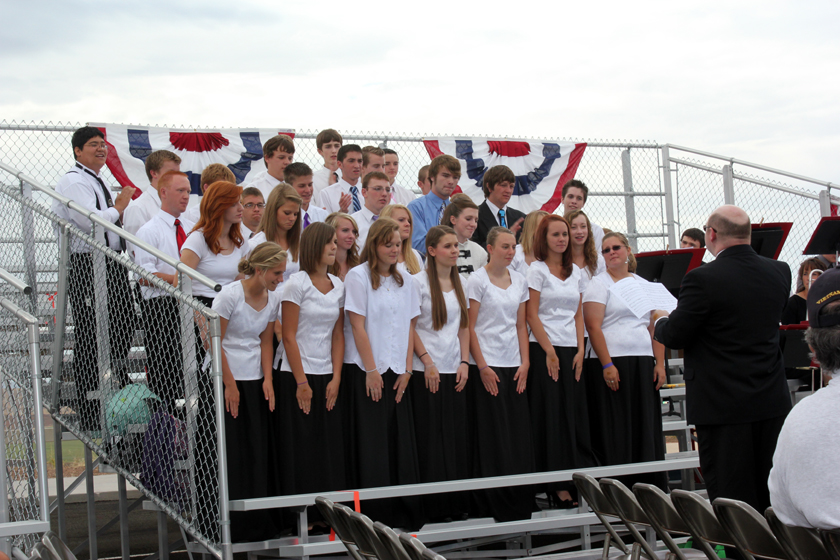
The Uintah High School Jazz and Marching Bands, and the Uintah High School Choir performed and the Jensen Veterans of Foreign Wars and Honor Guard Presented the colors.


Finally, Governor Herbert and the Vernal Area Chamber of Commerce cut the ribbon and the QEH was formally opened and the crowds poured in.


Behind the scenes the entire park staff was  busy with a vast range of activities from seating visitors, to directing traffic, providing security, preparing for medical emergencies, getting visitors on and off shuttle buses, and the myriad of logistical work that most of us don't see but are essential for a successful event. Planning and preparations for the Grand Opening had been going  on for months.

My friend and colleague Dr. Brooks Britt, paleontologist at Brigham Young University, gave up a faculty meeting to come out and help me with meeting and greeting Tuesday’s visitors and talk to them in depth about the exhibits and the Carnegie quarry story.
Yes, this is the same Dr. Britt who was the drummer for the Provo Accordion Cannibals (see my June 30 2011 post). Since he took off his nose and ear rings we allowed him to try on an NPS flat hat.

For a view of the opening from a visitor's perspective (albeit one who is a paleo blogger), see Brian Switek's fantastic Dinosaur Tracking at the Smithsonian on-line:
http://blogs.smithsonianmag.com/dinosaur/2011/10/americas-real-jurassic-park-re-opens/

Does the opening of the QEH and QVC mean adieu for this blog? Well not quite yet at least. There are some interesting things still to be told about the new exhibits, quarry history, etc. So if you, constant readers, will continue this trip with me, we’ll follow up on those topics in future posts.

Photos: Lorraine Chure