Friday, May 18, 2012

UPDATE: HELP SAVE THE MONGOLIAN TYRANNOSAURUS

If you would like to help save the Mongolian Tyannosaurus and other important dinosaur specimens slated for auction on Sunday, please go to  

http://www.change.org/petitions/heritage-auctions-stop-the-auction-of-illegally-collected-mongolian-dinosaur-fossils
 
and electronically sign the petition.  The dinosaurs will appreciate it.

Thanks!

Dan

MONGOLIAN DINOSAURS IN PERIL

Heritage Auctions, a large auction house in New York City, has a number of dinosaur fossils going on the auction block this Sunday.  A number of these are spectacular, including a complete skeleton of the giant Asian predator Tyrannosaurus bataar. But there are problems because there is evidence that at least some of the specimens were illegally collected and smuggled out of Mongolia, a country which prohibits the export of such objects.  The Mongolian government is alarmed and has stepped in.


**********************************************


Mr. Elbegdorj Tsakhia, President of Mongolia, in a strongly worded statement, has directed his government to investigate the origin of the specimens.


The office of the President of Mongolia, Public Relations & Communications Division

www.president.mn
2012-05-18

President of Mongolia is concerned that T-Rex skeleton may belong to Mongolia


President Elbegdorj Tsakhia talked to Minister of Education and Science, Mr.Otgonbayar calling his immediate attention to a dinosaur issue.

International science news on rare Tyrannosaurus Bataar skeleton to be auctioned on Sunday in NYC raised this alarm in Mongolia because the Heritage Auction website did not name the country where the T-Rex was found. The President of Mongolia, Elbegdorj Tsakhia, instructed Minister Otgonbayar to find all the information on the origin and route of the T-Rex fossil and to send an urgent appeal to the Heritage Auction for disclosure of this information before the Sunday auction.

If the T-Rex “uncovered in the Gobi Desert” originated in Mongolia, President Elbegdorj Tsakhia, said that it was illegal to auction the T-Rex and the fossil must be returned to Mongolia.

President Elbegdorj also called the international science community to help identify the origin of the T-rex and to alert the Mongolian government of any illegal international trade of Mongolian fossils.


 **********************************************


The Mongolian Academy of Sciences has written to Heritage Auctions pointing out that some of the specimens were without a doubt stolen from Mongolia and that others are highly suspect, and asking that there auction be halted. 

INSTITUTE FOR THE STUDY OF MONGOLIAN DINOSAURS

May 18, 2012

To Heritage Auctions:

I am writing you at the request of Elbegdorj Tsakhia, the President of Mongolia.  He has asked me to inquire on the country of origin for the specimen of Tyannosaurus (aslo known as Tarbosaurus) bataar (lot 49315) which is scheduled to be auctioned by your company this Sunday, May 20, 2012.  I am the director of the Institute for the Study of Mongolian Dinosaurs and also serve as the New York representative of the Mongolian Academy of Sciences.  Based on our experience in the studying the collecting of Mongolian dinosaurs, and on the information provided by your company with other specimens to be auctioned this Sunday, we strongly suspect that the Tyrannosaurus specimen, as well as several others you intend to auction, came from Mongolia.

Mongolian law prohibits the export of fossil specimens, and if this specimen did in fact come from Mongolia, we we strongly urge you not to auction this specimen because it would then have been acquired and exported illegally.  In fact, information on your website indicates that two of the tyrannosaur teeth (lots 49318, 49320) came from the Nemegt Formation, which is only exposed in Mongolia.  Thus these specimens were acquired and exported illegally.  We also strongly suspect that the ankylosaurus skull (lot 49317) came from Mongolia, and the troodontid , may have come from Mongolia as well (lot 49318).

The auctioning of such specimens fuels the illegal fossil trade and must be stopped.  If you could provide detailed information on the provenance(s) of these specimens, I will then pass on this information to the President of Mongolia.  I strongly urge you not to auction the two, illegally exported tyrannosaur teeth from Mongolia.  I strongly urge you not to auction the other specimens we have indicated until their legality is fully resolved.  Even if the owner indicates that they did not come from Mongolia, we suggest that you investigate this matter closely as sometimes collectors falsify information or documents to make illegal specimens appear "legal". In the meantime, the best approach would be an open dialogue with the government of Mongolia and other interested parties in order to find an acceptable resolution to this problem.  If it is eventually determined that these specimens did not come from Mongolia, it would be prudent for Heritage Auctions to consult the laws of the country of origin because many countries now prohibit the export or sale of such specimens (China is one example).  Thank you for your prompt attention in this matter.

Sincerely,

Bolortsetseg Minjin, Ph.D.
Director, Institute for the Study of Mongolian Dinosaurs
New York Representative of the Mongolian Academy of Sciences


**********************************************


Dr.Mark Norell, a world-renowned dinosaur specialist at the American Museum of Natural History who has worked extensively on Mongolian dinosaurs, has written the following open letter concerning the origin of the specimens and issues of legality.

THE AMERICAN MUSEUM OF NATURAL HISTORY

17 May 2012

Dear Sirs-

It is with great concern that I see Mongolian dinosaur materials listed in the upcoming (May 20) Heritage Auctions Natural History catalogue. For the last 22 years I have excavated specimens Mongolia in conjunction with the Mongolian Academy of Sciences. I have been an author on over 75 scientific papers describing these important specimens. Unfortunately, in my years in the desert I have witnessed ever increasing illegal looting of dinosaur sites, including some of my own excavations. These extremely
important fossils are now appearing on the international market.

In the current catalogue Lot 49317 (a skull of Saichania) and Lot 49315 (a mounted Tarbosaurus skeleton) clearly were excavated in Mongolia as this is the only locality in the world where these dinosaurs are known. The copy listed in the catalogue, while not mentioning Mongolia specifically (the locality is listed as Central Asia) repeatedly makes reference to the Gobi Desert and to the fact that other specimens of dinosaurs were collected in Mongolia. As someone who is intimately familiar with these faunas, these specimens were undoubtedly looted from Mongolia. There is no legal mechanism (nor has there been for over 50 years) to remove vertebrate fossil material from Mongolia. These specimens are the patrimony of the Mongolian people and should be in a museum in Mongolia. As a professional paleontologist, am appalled that these
illegally collected specimens (with no associated documents regarding provenance) are being are being sold at auction.

Sincerely,

Dr. Mark A. Norell
Chairman and Curator
Division of Paleontology
norell@amnh.org


 **********************************************


Time is short and it is uncertain whether or not the fossils in question will be auctioned. The auction is scheduled for Sunday May 20th at Heritage Auctions, Center 548 (548 W. 22nd Street, between 10th Ave. and West Street).  The specimens are on exhibit for for viewing on Saturday: 10:00 AM ET - 3:00 PM ET.


Saturday, May 12, 2012

MOTHER’S DAY 2012: Celebrating Ancient Sharks, Superfoetative Viviparity, and the Earliest Record of Sibling Rivalry


Montana, 318 million-years-ago. Red line is the equator and the black line marks 10 degrees north latitude.  Yellow circle is the site of the Bear Gulch Limestone.


Montana winters were certainly nicer during the Late Mississippian period some 318,000,000 years ago. Montana was much warmer --- it was only 12o north of the equator and over half the state was covered by shallow, warm, tropical seas.  Although the skiing and snowboarding was non-existent the surfing was vastly improved.  Of particular interest to this post is an area in central Montana that during Mississippian times was a shallow bay, only 40 meters deep and 15 km long.  Today the sediments deposited on the floor of this bay are known to geologists and paleontologists as the Bear Gulch Limestone (BGL) and those rocks are world renowned for their truly spectacular fossil record . 


The fossil bearing beds of the Bear Gulch Limestone.

The Bear Gulch Limestone occurs in repeated layers that separate well so it is not surprising the fossil beds were discovered by local ranchers who were quarrying it for ornamental building stone.  Although only discovered in 1977, the BGL has yielded about 130 species of fish, some 65 of which are chondrichthyans, the “cartilaginous” fishes, such as primitive sharks, rays, and holocephalans. 

Because most of their skeleton consists of cartilage rather than bone, and cartilage has a much lower fossilization potential, a great deal of  the fossil record of sharks looks like this.....


.... little more than shed and isolated teeth.  The spectacular fossilization in the BGL, preserves not only cartilaginous skeletons but soft internal tissue as well as skin. Thus it is no wonder that the Bear Gulch Limestone is one of our best windows onto life of the Mississippian. 

And it’s because of that remarkable preservation that we turn to the Bear Gulch Limestone and two of its primitive fish to celebrate Mother’s Day 2012.  


**********************************


Harpagofututor and the Joys of a Large Family

The spotted ratfish (Hydrolagus colliei), a living holocephalan.

Harpagofututor is a primitive member of the Holocephali, a group of still living cartilaginous fishes.  They are known by a variety of popular names (rat fish, chimaeras) and most of the 34 living species inhabit deep sea environments, with a few species preferring shallow water.  Although an ancient lineage, originating some 400,000,000 years ago, holocephalans remain poorly known to the general public.


Sexual differences in Harpagofututor.  Top is a female.  Bottom is a male.  Arrows point to the head appendages characteristic of males of this species of fish.

Harpagofututor is not a particularly large fish, reaching a maximum size of 165mm (~7in).  It has an elongate, eel-like, body and is known from numerous specimens. This fish comes in two forms, one with a “normal head” and the other with two large cartilaginous appendages projecting from the top of the skull in front of the eyes. Each appendage is jointed at mid-length and there is a moveable ball and socket articulation with the top of the skull.  The end of each appendage was a long thin fleshy extension bearing numerous small hooks. The two forms are otherwise quite similar and these striking differences are due to sexual dimorphism, with the male using the appendages for display or to hold onto the female during copulation, as do some living holocephalans.

The unadorned skull of a female Harpagofututor.


The skull of a male Harpagofututor, showing the large, paired, jointed, cartilaginous appendages (colored red) that moveably articulate with the top of the skull.
However, Harpagofututor was thoughtful enough to confirm this suspicion of sexual dimorphism by having two unornamented specimens preserved with embryos inside the body cavity, confirming them as female.  Sometimes the fossil record plays nice.  

The number of embryos preserved is 4 in one specimen and 5 in the other. Within each group one embryo is distinctly larger (based on skull size), with the skull length of the largest approaches that of adults. Thus it would appear that Harpagofututor young were born live (known as viviparity) and at a large size. This would give the newborns a distinct advantage in obtaining food and surviving.

A pregnant female Harpagofututor. A. Fossil with mass of embryos in abdominal area circled in yellow.   B. Line drawing of A.   C. detailed drawing of the five embryonic skulls.  Note range of size of skulls.  Scale bar = 1 cm.


The larger individuals in each female are clearly at a more advanced stage of development than its litter mates.  This is most likely due to superfoetation, where a female carries multiple litters and the young exhibit distinctly different stages of development.  Thus what we are seeing are young that came from eggs fertilized at different times.  This might be due to separate copulations after separate ovulation events, or from a female storing sperm from only one copulation and using it to fertilize eggs from different ovulation cycles.  In some of the female specimens with soft tissues preserved, sperm receptacles are present, suggesting that female storing of sperm occurred in Harpagofututor.  

A second pregnant Harpagofututor. A. Photo of Specimen.   B.  Line drawing of A, showing embryonic skulls.  C. Photo of  largest of the embryonic skulls.  D. Line drawing of two embryonic skulls. Scale bar = 1 cm (in mm).
  
Harpagofututor is the only known case of superfoetation in the fossil record. It has evolved numerous times in boney fish but this is only the second known record for cartilaginous fishes.  The other is that of a living whale shark carrying 300 young at three different developmental stages.  

So now knowing a little bit about the morphology and biology of Harpagofututor, you can better appreciate the meaning of the name, which is derived from harpagos, grappling hooks, and fututor, copulator, in reference to the secondary sexual apparatus of the males of this species.


**********************************

Old Womb Tooth and the First Sibling Rivalry

The other star of this post is Delphyodontos  and we only know of it because of the spectacular fossilization found in the BGL. Only two Delphyodontos specimens have been described in the scientific literature, and both are very small, although larger, newly discovered specimens are currently under study.

One of the two known specimens of Delphyodontos.  Note preserved fecal sac at the back of the abdomen. Total length 29mm (1.2 in).
 
Delphyodontos is a primitive cartilaginous fish.  The two described specimens measure 35mm (1.4 inches) and 29mm (1.2in) respectively. Its shape is peculiar, with an enlarged abdomen, poorly developed fins, and an arched backbone.  These features indicate that Delphyodontos was relatively helpless and not capable of swimming. However, these features are also characteristic of a fetus. The known specimens are most likely spontaneously aborted late term fetuses.

What is even more intriguing than its body shape is its teeth. The upper and lower tooth plates are compressed, blade like, and bear tall cusps.  This tooth structure is adapted for slashing and piercing.  That's unique for holocephalans for all other known members of the group, both living and fossil, have crushing tooth plates.  Although Delphyodontos adults have not yet been described, it is highly likely that they had crushing teeth as well.  So what would a Delphyodontos fetus need such teeth for?  In addition, there is no evidence of a yolk sac or umbilicus, so what was the fetus feeding on? 

Drawing of the piercing, slashing teeth of Delphyodontos.
The answer comes from the smaller specimen, in which a large fecal mass is preserved in the back of the abdomen.  Since these small, fetal fish were not capable of swimming yet show a fecal mass in the gut, they must have been feeding inside the female before birth.  There are, surprisingly, food sources within the mother, notably other eggs. Such intrauterine feeding is known in living cartilaginous fishes, where the yolk sac is absorbed early in development and specialized dentition is used to open egg capsules and consume the contents.  In some cases, the mother shark provides a steady supply of unfertilized eggs as a food source. The fetus of some modern intrauterine feeding sharks show an expanded foregut, as in Delphyodontos.

So as peculiar as Delphyodontos looks, its features give us insight into its biology, even before birth.  And if eating the other eggs sharing the uterus with you isn’t sibling rivalry, then I  have no idea what is. 

Even though every blasted dinosaur species has been fleshed out multiple times, this is the only available restoration of Delphyodontos and shows the overall embryonic shape of the specimens.

Hopefully, knowing about the biology of Delphyodontos gives you a better appreciation of its name, which is derived from delphyo, womb, and dontos, tooth.


I wish all my readers a happy 2012 Mother's Day.  Go ahead, give mom a hug and a kiss and, if you feel like it, gobble down a couple of eggs in memory of old Delphyodontos.  

But stay tuned for my Father's Day post.  I already have it plotted out.  


*****************************************************


PHOTOS
Paleogeographic map,  BGL outcrop, photo of male and female Harpagofututor, and photo of Delphyodontos specimen (some modified): Fossil Fishes of Bear Gulch  http://www.sju.edu/research/bear_gulch/


Drawings of male and female skulls of Harpagofututor (modified):  Lund 1982 (below).


Two pregnant Harpagofututor specimens (modified): Grogon and Lund 2011 (below)

Drawing of jaws and teeth of Delphyodontos (modified): Lund 1980 (below)

Delphyodontos flesh restoration: http://en.wikipedia.org/wiki/Delphyodontos


SOURCES

Fossil Fishes of Bear Gulch. www.sju.edu/research/bear_culch/index.htp

Grogon, E.D. and Lund, R. 1997. Soft Tissue Pigments of the Upper Mississippian Chondrenchelyid, Harpagofututor volsellorhinus (Chondrichthyes, Holocephali) from the Bear Gulch Limestone, Montana, USA.  Journal of Paleontology, Vol. 71 (2): 337-342.
Grogon, E.D. and Lund, R. 2002. The geological and biological environment of the Bear Gulch Limestone (Mississippian of Montana, USA) and a model for its deposition.  Geodiversitas 24(2): 295-315.

Grogon, E.D. and Lund, R. 2011. Superfoetative viviparity in a Carboniferous chondrichthyan and reproduction in early gnathostomes.  Zoological Journal of the Linnean Society 161: 587-594.

Hagadorn, J.W. 2002. Bear Gulch: an exceptional Upper Carboniferous Plattenkalk. In Bottjer, D.J., Etter, W., Hagadorn, J.W., & Tang, C.M. (eds.) Exceptional Fossil Preservation: A Unique View on the Evolution of Marine Life. New York: Columbia University Press: 167-183.

Joung, S.J., Chen, C.T., Clark, E., Uchida, S.W., and Huang, Y.P. 1996. The whale shark, Rhincodon typus, is a livebearer; 300 embryos found in one ‘megamomma’ supreme. Environmental Biology of Fishes 46: 219-223.

Lund, R.  1980. Viviparity and intrauterine feeding in a new holocephalan fish from the Lower Carboniferous of Montana. Science 209 (4457): 697-699.

Lund, R. 1982. Harpagofututor  volsellorhinus new genus and species (Chondrihthyes, Chondrenchelyiformes) from the Namurian Bear Gulch Limestoine, Chondrochelys problematica Tarquir (Visnean) and their sexual dimorphisms. Journal of Paleontology 56(4): 938-958.


Saturday, April 28, 2012

DROP DEAD DELICIOUS


A Pacific Humpback Whale calf.

A baleen whale carcass, at a depth of 9800 ft, on the floor of Monterey Canyon.

The deep ocean floor (greater  9800 ft deep) is an inhospitable place of cold (36F), great pressure (4400 pounds/in2), and permanent, absolute, unrelenting darkness. The earth’s surface, including the sea floor, is composed of a series of large, mobile plates. It wasn’t until 1977 that marine geologists discovered hydrothermal vents, sites where plates are moving apart on the ocean floor and water heated by magma, surges out of the crust at temperatures as high as 870oF and as acidic as vinegar. The heated water comes spewing out as black or white smokers.

At a vent resort vestimentiferan worms enjoy the good life as two black smokers eject 800F water.


In contrast to most of the deep sea floor, vent systems have diverse and abundant life.  This diversity of vent life is even more amazing because it occurs in darkness. Most ecosystems depend on sunlight, converted to biomass through photosynthesis, as the source of energy that drives the system.  But light only penetrates a few hundred feet in the ocean.  So without light, and therefore without photosynthesis, how do the vent communities survive, much less prosper?

My  molecular biologist / bio-chemist son has drummed into me that almost everything starts with and ultimately depends on microbes.  The hydrothermal vents are no exceptions.  The super heated water is rich in sulphur and other dissolved minerals. Archaean bacteria specialize in metabolizing those minerals and converting them to energy, a chemical analog of phontosynthesis known as chemoauthotrophy That abundance of those microcorganisms forms the basis for the food web and animal communities that live in the vent ecosystems.  

Thousands of white vent crabs exemplify the abundance of life found around vents, these in the Antarctic Ocean.
How rich is life at the vent systems?  In spite of the difficulty of visiting these sites and the problem of trying to sample life forms at such great depths, a new species of vent life has been named in the scientific literature every two weeks since the first paper in 1979. 

However, the volcanic activity on the sea floor is not consistent long term and can turn off in some areas and appear in others further away.  So the animals living at the vents must be able to get around, maybe great distances.  Many vent organism are sessile and cannot move and many others cannot mover great distances.  Besides, leaving the area of the vent means traveling from a warm area into the frigid cold.  For many animals it’s the larvae, rather than adults, that are carried far away by currents and hopefully land in a favorable spot of the deep sea floor.

During a deep sea dive in 1987, researchers accidentally came across the skeleton of a blue or fin whale in the Santa Catalina Deep.  This was the first whale carcass to be observed on the deep sea floor. What was remarkable was the large number of organism living on the carcass, many of which were not seen elsewhere on that sea floor, although a number of them were known from vent communities elsewhere.  Mats of  chemoautotrohphic bacteria covered the seafloor and bones and other species present host such bacteria internally and live off the energy released by the bacteria. What had been discovered was a chemoautotrophic community like those of the vent communities, living on a dead whale.

Although there were no hydrothermal vents at the whale site, the bacteria were performing their miracle by metabolizing the fats in the whale bones!  Since that time other natural deep sea whale fall occurrences have been found, but those discoveries are dependent upon luck.  To better understand decomposition of whales and their utilization a number of whale carcasses have been sunk to the sea floor and their exact location recorded so they can become subjects for long term studies.  This is now a rich field of study and has revealed much about the ecology of the deep sea floor.

Snacking at the Cafe Cetacea. Multi-colored bacterial mats metabolize bone fats (top left), hagfish consume soft tissue (top right), bone-eating worms feast on the skeleton (bottom left) and vent crabs do general clean up (bottom right).

Some food falls to the deep sea floor from higher in the water column, but at a very slow rate, and has been names “marine snow”. Much of it is small to microscopic. A 40 ton whale carcass sinking to that sea floor provides the equivalent of 200 years worth of food from marine snow.  And whale arrives as single, all be it very large, package --- and the largest cetacean, the blue whale, reaches a greater weight of 200 tons!  Although several stages of decomposition  of the carcass can be identified, the longest lived stage is that of the vent community organisms  that colonize and consume the bone lipids. This community includes certain bacteria, as well as specific groups of crabs and other crustaceans, clams, snails, worms, and others. Some species occur in the tens of thousands of individuals.  Given that the bones of large whales can be 60% lipid by weight and the cold temperature in deep water, large whale skeletons may last more than 50 years on the sea floor.

These whale skeletons thus serve as a way station of sorts, where deep sea communities can grow  and ultimately send their larvae on to colonize other shale carcasses or real hydrothermal vents on the sea floor.  Some estimates place whale carcasses, at least along whale migration routes, as close together as 6 miles. So the death of these air breathing giants provide crucial food and colonization sites for some of the most specialized deep sea organism in the ocean.

*****************************

Whenever I read about an interesting biological phenomenon, like our tale of the whale, I often wonder how far back in time the phenomenon originated.  Fortunately, the fossil record can often provide some insight and constraints.

The earliest whales evolve from terrestrial ungulate mammals by the Eocene, some 40 million years ago.  These are predatory, primitive whales achieve lengths of 50 feet or more.  However, the bone structure of these whales shows that they had not yet evolved the high oil content in their bones.  So it is not too surprising that no vent community type fossils are known from those fossil skeletons.  It is not until the Miocene, about 11-15 million years ago, that whale fossils with associated invertebrate fossil characteristics of vent communities first appear, when the bone oil content  reaches critical mass.


What of the fossil record of vent communities?  Hydrothermal vents on the sea floor occur far back in time, billions of years, even before life first evolved.  More than 50 fossil hydrothermal vents with an associated fossilized communities are known, extending as far back as the Cambrian in China, some 522 million years ago.
*****************************

I can’t manage to drag dinosaurs into this post.  Although dinosaurs were the dominant large land dwelling vertebrates of the Mesozoic, and took their phenomenal success to the air when small maniraptoran theropods evolved into birds, they never evolved into aquatic or marine forms.  That’s not to say that dinosaurs aren’t found in marine rocks.  Hadrosaurs, ankylosaurs, and therzinosauroids have all been recovered from marine environments and some even laid on the sea floor long enough to have oysters begin to grow on their bones.  However, all these occurrences are of terrestrial dinosaurs whose carcasses floated out to sea, either from the shoreline or carried out by a river.  While they came to rest on the sea floor, they did not live in the ocean.  Having normal bones with low fat content, it is no surprise that vent community organisms have never been found on one of those skeletons.

Although dinosaurs never invaded the fresh and salt water realms, other groups of Mesozoic reptiles did, and some achieved large size. Ichthyosaurs, reptiles resembling  dolphins and porpoises,  grew quite large (up to 70 feet in length) and some were deep diving predators.  Mosasaurs are ocean-going predatory marine lizards, related to the Komodo dragon, the largest of which achieved a length of 57 feet (17.5m).  The plesiosaurs are the final large group of predatory Mesozoic marine reptiles and reached 20 m (? Ft) in length.  Certainly the largest members of each of these groups would be a tremendous food packet when a carcasses fell to the sea floor, just like a whale, and several paleontologists have speculated on the ecological effects of such events. 

The largest known Mesozoic marine reptiles compared to a sperm whale and a scuba diver.  
In 2008 a paper appeared providing the first documentation of a Mesozoic marine reptile with fossil remains of a chemoautotrophic community preserved in intimate association with a skeleton --- in fact two such skeletons of plesiosaurs.  Although one cannot directly measure the oil content of these ancient bones, the abundance of iron sulfide inside the plesiosaur bones is evidence of bacterial sulfate reduction of bone lipids. Numerous snails and clams among the bones of the skeletons belong to groups that occur at modern day and fossil hydrothermal vents.

Part of a Cretaceous plesiosaur reptile skeleton from Japan, with vent community snails (yellow circles) and clams (blue circles) organisms preserved between the bones.

A collection of fossil snails from the plesiosaur skeleton.
 Many of the snails and other fossils associated with these plesiosaur skeletons are small and the authors make the point that future Mesozoic marine reptile skeletons need to be carefully prepared with an eye to documenting and preserving any associated invertebrate fossil.  There is the possibility that in the past vent fossils associated with plesiosaur, ichthyosaur, and mosasaur skeletons may have been overlooked or prepared away in the effort to extract the fossil bones from matrix.  I suspect that future work will reveal more vent/reptile fossil associations and show that at least some of those ocean going giant reptiles were the whale falls of the Mesozoic.

*****************************

Sometimes putting together a Land of the Dead post is pretty straightforward, at other times less so. I have been following research on hydrothermal vent communities pretty much since their discovery.  Not that I read every scientific paper on the subject, far from it, but I do have enough of a fascination with them that I’ve put visiting a deep-sea hydrothermal vent community on my “bucket list”.  And I remember when the discovery of hydrothermal vent communities on whales fall was first announced. 

A number of weeks ago I watched Into The Deep, an episode of the PBS series American   Experience, about the history of sperm whale hunting out of Nantucket Island and the sinking of the whaling ship Essex in 1820 after being “stove by a whale” in the middle of the Pacific Ocean. I knew very little about that part of American History, so it was eye opening. Following that I listened to Philbrick’s In The Heart Of The Sea, a magnificent book about the Essex disaster, and one I highly recommend as a most remarkable, and long forgotten, story of extreme survival at sea.  That led to Dolin’s Leviathan, a history of North American whaling from 17th through 19th centuries.   Leviathan begat my current reading project, Whitehead’s  Sperm Whales: Social Evolution in the Ocean, a remarkable overview of the biology of a most remarkable animal.

Somewhere in all of this I got the idea for a post about whale falls past and present which led me to the work of marine biologists Smith, Baco, Kiel, Higgs, and others. Researching  the paleontological record of whale falls, ancient marine reptiles, and associated fossil vent communities led to the work of Hogler, Kiam, Martill, and others. Those who know me will recognize the behavior exhibited here. “Dan’s got a new favorite” is how it was once described.

When I finish Whitehead’s book it will be time to move on to some other topic. However, the circuitous path for the whale fall post is a manifestation of what the Nobel Prize winning theoretical physicist Richard Feynman described as “the joy of finding things out.”  Coming across a small fact can lead you to learn about a fascinating area about which you knew little about ---- if you are willing to follow your nose.  Nose following is probably preferable to chasing one’s tail, although I will need to check with Nut and Buster, my two resident experts on such matters, to get a professional opinion. 


And no, I haven’t read Moby Dick!!


  *****************************


SOURCES

Dolin, E.J. 2008. Leviathan: The History of Whaling in America. W.W. Norton and Co.: 512 pp.

Goedert, J.L, Squires, R.L., and Barnes, L.G. 1995. Paleoecology of whale-fall habitats from deepwater Oligocene rocks, Olympic Peninsula, Washington State. Paleogeography, Palaeoclimatology, Palaeoecology 118: 151-158.

Goffredi, S.K., Paull, C.K., Fulton-Bennett, K., Hurtado, and Vrijenhoek, R.C. 2004. Unusual benthic fauna associated with a whale fall in Monterey Canyon, California.  Deep-Sea Research 51: 1295-1306.

Higgs, N.D., Little, C.T.S., and Grover, A.G. 2011.  Bones as biofuels: a review of whale bone composition and implications for deep-sea biology and palaeoanthropology.  Proceedings of the Royal Society B 278: 9-17.

Hogler, J.A. 1994. Speculations on the role of marine reptile deadfalls in Mesozoic deep-sea paleoecology. Palaios 9: 42-47.

Kaim, A., Kobayashi, Y., Echizenya, H., Jenkins, R.G., and Tanabe, K. 2008. Chemosynthetic-based associations on Cretaceous plesiosaurid carcasses. Acta Palaeontologica Polonica 53(1): 97-104.

Kiel, S. and Goedert, J.L. 2006. Deep-sea bonanzas: early Cenozoic whale-fall communities resemble wood-fall rather than seep communities.  Proceedings of the Royal Society B 273: 2625-2632..

Martill, D.M., Cruickshank, A.R.I., and Taylor, M.A. 1991. Dispersal via whale bones. Nature 351: 193.

Philbrick, N. 2001. In the Heart of the Sea: The Tragedy of the Whaleship Essex.  Penguin: 302 pp.

Pyenson, N.D. and Haasl, D.M. 2007. Miocene whale-fall from California demonstrates that cetacean size did not determine the evolution of modern whale-fall communities. Biology Letters, Royal Society London 3: 709-711.

Smith, C.R. and Baco, A.R. 2003. Ecology of whale falls at the deep-sea floor.  Oceanography and Marine Biology: an Annual Review 41: 311-354.

Smith, C.R., Kukert, H., Wheatcroft, R.A., Jumars, P.A., and Deming, J.W. 1989. Vent fauna on whale remains.  Nature 341: 27-28.

Wang, X.Q., Shi, X.Y., Jiang, G.Q., and Zhang, W. 2012. New U-Pb age from the basal Niutitand Formation in South China: implications for diachronous development and condensation of stratigraphic units across the Yangtze platform  at the Ediacaran-Cambrian  transition. Journal of Asian earth Sciences 48: 1-8.

Whitehead, H.   2003. Sperm Whales: Social Evolution in the Ocean. University of Chicago Press: 464 pp.


Monday, April 2, 2012

UPDATE: The Dancing Worm of Turkana

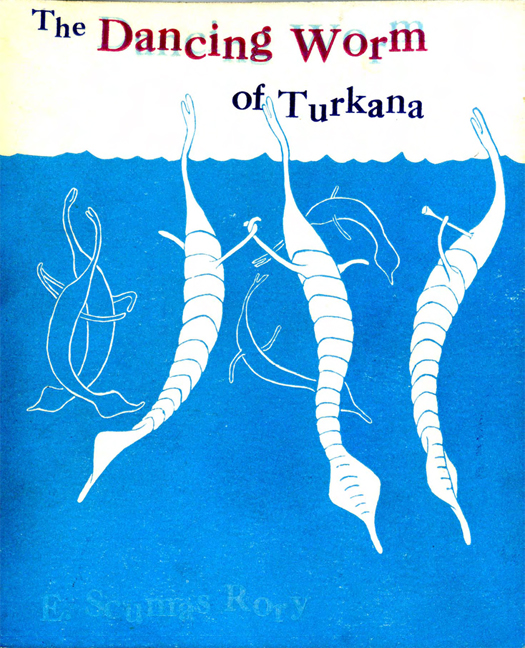
Since yesterday's post on Tullimonstrum gregarium, a copy of Rory's 1969 27 page booklet "The Dancing Worm of Turkana" has come into my possession. For those  interested in a pdf of this work, please email me via the View My Complete Profile link on the right side of this page.


Sunday, April 1, 2012

LIVING FOSSILS: Tullimonstrum gregarium and The Dancing Worm of Turkana


The tully monster is a truly weird fossil, so much so that I want to make it clear up front that I have not concocted this animal as part of an April Fool’s joke. Specimens range in size from 3 to 15 inches (8-35 cm).  It is soft bodied, with no external hard parts. The elongate shape can be divided into three regions.  The blunt tail end bears fins on each side.  The head region has an elongate proboscis that terminates in a pair of jaws with eight small sharp “teeth”.  The trunk is segmented and bears a bar shaped structure that projects sideways.  Each end of the bar is expanded and pigmented.  These expansions are apparently eyes. Although this animal looks most like something from a cheap 1960s Japanese scifi flick, the anatomy is well understood, as literally thousands of its fossils have been found. 

Above and blow: A scientist's view of the Tullimonstrum.


A model of Tullimonstrum, showing the creature's peculiar shape and details of the toothed proboscis.

The first specimens were discovered in 1958 by amateur fossil collector Francis Tully of Lockport Illinois who brought them to the Field Museum of Natural History where they came to the attention of the famous Curator of Fossil Invertebrates Eugene Richardson. Richardson wrote or co-authored the first scientific publications on it. Tully’s role in the discovery of this strange antiquarian beast was recognized in its name Tullimonstrum (Tully’s monster).  The species name gregarium means “common” and refers to the abundance of specimens of it. Ironically, “tull” means “nonsense” in Norwegian --- also an apt description. Eventually it became the state fossil of Illinois.

Amateur fossil collector Francis Tully and and a fine complete specimen of his monster.
Tullimonstrum was a free-swimming predator of the open ocean. In spite of its abundant fossil record its evolutionary relationships are poorly understood. Although similarities to a variety of marine invertebrate groups has been suggested, none of these ideas are very well supported and the creature’s evolutionary position remains a mystery.  


So far this was an interesting scientific story --- an enigmatic but abundant fossil species with very, very peculiar morphology and unknown evolutionary relationships --- just the kind of fossil that intrigues and puzzles paleontologists.  However Tullimonstrum would soon move beyond the pages of dry, scientific journals.

In July 1966 Richardson wrote a popular account of the Tully monster and his research on it.  This included a cover illustration of restored Tullimonstrum swimming and feeding in the ancient Pennsylvanian sea of Illinois.  The story was picked up by the press and got wide circulation in newspapers, including the East African Standard of the former British Colonies of East Africa.

In September of 1966 Richardson received a letter from R.G.I. Cloudesley (a retired Lieutenant–Colonel of the Kings African Rifles) then living in Nairobi, Kenya. Cloudesley recounted that 40 years previously he had had been told by a Mr. A.M.A Champion (then District Commander of Turkana and a skilled naturalist) about an unusual giant worm that lived in the lakes of the area. Champion had heard about this creature from local Africans but had never been able to actually obtain a specimen. Cloudesley remembered the worm as having “paddles and a long snout” so that when he read the news stories about the Tullimonstrum he thought it wise to pass this information on to Richardson in case there was call to follow up on it.

As Richardson was preparing a reply to Cloudesley a letter arrived from a Mr. Purshottan S. Patel of Kenya reporting that something like the Tullimonstrum might be living in Turkana, at least based on stories he had been told by  relatives of a dancing worm in the lakes. Excited, Richardson began researching what was known about the animal life in these areas.  Turns out they were poorly explored and documented areas of the Earth and such an animal might yet well dwell there undiscovered by scientists.

Next Richardson get a letter from an intermediate school teacher from Nakuru, a Mr. Joseph A. Ngomo, who said that his class had read the Sunday Standard that carried the Tullimonstrum story and several students told him they had heard of such a worm from their fathers.  Ngomo included a note from Akai (son of Ekechalon) who recounted, in child’s writing that the worms, swim and “wave hands” during the full moon, and have a bite fatal to humans.

By this point discussions started up at the Field Museum amongst Richardson and other staff that, given the anecdotal but intriguing reports, an expedition might be warranted.  Finding a living relative of the Tullimonstrum would be a really important scientific discovery. The museum published a note in the Newsletter of the East African Natural History Association, hoping more information might be obtained, but there were no responses.  That was not too surprising given how little biological scientific work had been done in those remote areas. Local myths and folklore sometimes prove to be true.    

Early the following year the museum was visited by Dr. Bryan Patterson, a famous paleontologist who studied fossil mammals.  Patterson had been the Curator of Vertebrate Paleontology at the Field Museum but was now a professor at Harvard University. Patterson had just returned from field work in Kenya and happened to know Patel’s uncle. He considered him a bit of a rascal.  Richardson told Patterson of the Tullimonstrum and showed the various letters to him.  Patterson read them with amusement and confessed he had never heard of the dancing worms.   

Later it came to light that Patterson had many reasons to be amused because Cloudesley, Ngomo, Patel, and Akai turned out to be all the same person ---- none other than the illustrious Bryan Patterson.  Of the ten people in the Field Museum who had been hoodwinked only one was in on Patterson’ little prank. That prevented it from going too far and causing professional or institutional embarrassment, after all Patterson was running this from the other side of the globe and couldn’t keep track of how the prank was progressing. It was a clever joke that played on the desires, hopes, and scientific passions of all involved.  He was giving the Field Museum what they wanted --- living relatives of the Tullimonstrum.   If the fossil wasn’t so perplexing and problematic it wouldn’t have been so alluring.

The illustrious Bryan Patterson and the illusive Dancing Worm of Turkana.
One last bit to the story.  Richardson received a Christmas letter in 1968  that on the front carried a photo of Bryan Patterson in full African field regalia holding a rifle in his right and  and hanging from his left hand a recently shot good sized Tullimonstrum, with the proboscis and horizontal bar clearly visible.  Inside was a poem and under the phrase "The End of the Hunt" were the signatures of Cloudsley, Ngomo, Patel, and Akai!

The staff took the leg pulling in good humor and admitted they had been had by a professional. Several years later Richardson even wrote a short book, under another name, about the Dancing Worms of Turkana.  Edward Nash, the editor of the Bulletin of the Field Museum of Natural History wrote an account of the whole story and admitted being taken in by it.  He included a copy of the hunting photo as well as the inside of the card with the Kenyan signatures.  He also reproduces in full, all the letters from Kenya concerning the discovery, only some of which I have mentioned here.

*******************************
Over the years there have been several notrious incidents of intentional deception in paleontology, the 18th century “lying stones” of  Johann Bartholomeus Adam Beringer and the early 20th century Piltdown Man fake immediately come to mind.  However, those were done maliciously in an attempt to destroy the professional career of a scientific rival.  The Dancing Worms of Turkana is a totally different beast, one done in good humor and with precautions taken to not do any real damage.  Like many movies in the 1930s. the closing scene has everyone laughing together side by side.

Artwork of Tullimonstrum, the state fossil of Illinois, can be seen emblazoned on the sides of U-Haul trucks and trailers.


*******************************

Photos
Scientist's views: Johnson  and Richardson 1969 (below)


Patterson and the Worm: Nash 1968 (below)


Sources
Johnson, R.G, and Richardson, E.G. 1969. Pennsylvanian invertebrates of the Mazon Creek area, Illinois: The morphology and affinities of Tullimonstrum. Fieldiana: Geology  12 (8): 119–149.

Nash E.G. 1968.  The quest for the dancing worm. Bulletin of the Field Museum of Natural History 39(4): cover + 4-6 http://archive.org/details/cbarchive_107413_thequestforthedancingworm1966

Kloss, G. June 18, 1968. The Great Dancing Worm Hoax. The Milwaukee Journal.  

Richardson, E.G. 1966. Wormlike Fossil from the Pennsylvanian of Illinois. Science 151(3706): 75-76 

Richardson, E.S. The tully monster. Bulletin of the Field Museum of Natural History 37(7): cover + 4-6.  July 1966 <http://archive.org/details/bulletin37312fiel>


Rory, E Scumas (Richardson, E.G.)  1969. The Dancing Worm of Turkana. Vanishing Press: 27 pp.


Wednesday, February 29, 2012

A PERMIAN PALEOBOTANICAL POMPEII


There is a mythology of sorts about finding dinosaurs.  Every skeleton is beautifully complete from the tip of the snout to the end of the tail. Each bone is in its life position. The most delicate feature is preserved uncrushed.  This propaganda is furthered by films, such as the Velociraptor excavation scene in Jurassic Park.  If only it were so.  Most of us deal with skeletons much less complete and more difficult to interpret.  But the beautiful specimens get the better press.  That’s understandable. 

The situation is worse with plant fossils. Leaves and twigs, cones and flowers, roots and trunks, and all other plant parts become easily separated and scattered by water and wind or are quickly destroyed. Finding a cone attached to foliage might allow you to connect it with a branch preserved with that kind of foliage attached which might allow you to connect it to a trunk with that kind of branch attached. Such a series of fortunate discoveries will allow you to reconstruct what the total plant looked like.  Bigger questions, such as what the total plant community was like, how closely spaced or scattered were the different plants, or what was the relative abundance of the different plant species require yet more remarkable preservation, that of a whole forest. A just published paper provides just such a rare insight into an ancient coal swamp in Inner Mongolia.

Being able to accurately reconstruct how an ancient plant community is structured requires rapid burial of the forest, something on the order of hours or days, and with no transport of the dead plants.  For such a special situation one needs the help of a volcano, and a special kind of volcanic eruption at that -- a volcanic ash fall like that of Mount Vesuvius which buried the famous Roman cities of Pompeii and Herculaneum in 79 AD.

Just such a large eruption occurred some 298,000,000 years ago near what is now Wuda in Inner Mongolia.  The ash fell onto a Permian peat - coal swamp.  As the ash fell it broke off branches, twigs, leaves, and cones, toppled trees, and eventually buried the forest in-place under a 100 cm (~40 in) thick ash layer.   The floor of this forest was a thick layer of peat composed of partly decomposed plant material permanently under several centimeters of acidic water.


1. The 80 foot tall Sigillaria (A) and slightly shorter Cordaites (B) were the tallest swamp trees at Wudan.
The quality of preservation at Wuda is outstanding and provides a fantastic record of the plant life.  Because the heights of many of the plants can be determined with confidence, we get insight into the vertical structure of the forest. The tallest trees (Sigillaria) towered over the rest of the trees, growing as tall as 25 m (82 feet) forming a sparse upper canopy.  The slightly shorter Cordaites is a primitive conifer-like tree.


2. Several species of tree ferns, at a height of 10-15 meters (32-50 feet), formed an actual canopy across the swamp.


3. The enigmatic Noeggerathiales (A) and several types of primitive cycads (B) were shorter trees forming a lower canopy in the forest.


4. In areas where the water was very shallow or the peat emergent, sphenophytes  (A Sphenophyllum, B Asterophyllites) and ferns (C) formed a sparse and patchy ground cover.

While this fossil site gives us a remarkable amount of information, it includes more treasures. Because it was fossilized in-place over a short period of time by an ash fall, the bases of the trunks and roots of plants were preserved in life position. This allows us to reconstruct how the different types of plants were distributed across the swamp.

5. A reconstructed part of the Wudan swamp forest showing the vertical structure and horizontal distribution of the plant life.  The tallest plants (Sigillaria) reached heights of 80+ feet. Water covered the forest floor for most of the year.
 Wang and his co-authors were able to map 1000 m2 of the ancient swamp floor and record exactly where each type of plant lived.  In modern day living forests, such mapping on the scale of 200-500 m2 is considered sufficient for characterizing the forest structure.  To be able to do twice a well in a 298,000,000 old forest is just remarkable.

6 Another reconstructed area of the Wudan swamp forest showing the variation in the structure of the plant community.  As in 6, the tallest plants are 80+ feet and water covered the forest floor for most of the year.

*********************************
Not all fossil forest are like that at Wuda. Petrified Forest National Park is probably the most famous fossil forest in the world.  However, the abundant and sometimes immense logs are not preserves in life position.  The downed trees were transported and  buried in ancient river channels --  a fossilized log jam of sorts.

Specimen Ridge in Yellowstone National Park is an eight mile long cliff face with dozens of fossil forests exposed on its 2000 ft vertical surface.  While these forest are piled up on one another layer by layer, no single flat surface is exposed that shows how the trees were distributed across the forest floor.  This begs the question “So how were paleobotanists able to map the fossil plants at Wuda?  The answer is simple --- mining.

7. Aerial view of the Wudan coal mining operation (dark areas). 

The Wuda forest is located between coal seams numbers 6 and 7 in the Wuda coal field. The ash can be seen in cross section in mine tunnels.  But to conduct the kind of study done there, a great deal of overlying rock had to be removed to get to the forest layer, at firt through normal mining information and later by the intensive and rapid mining associated with efforts to put out a severe coal mine fire. As the mining operations progress, they remove layer after layer of coal, eventually providing access to hundreds of square meters of the ancient forest floor.  A power shovel was used to break the ash layer into blocks that were then split by hand and their contained fossils mapped on a grid system. The stunning fossils needed to be quickly collected because erosion was rapid once the rock surface was exposed.


Mining operations are often quite destructive when it comes to fossils. Fossils are destroyed simply by the very act of excavating vast amounts of rock from deep in the earth.  However, there are times when mining operations enable paleontologists to study a record of the past that would otherwise never have been seen.  Several other forests like that at Wudan have been similarly studied in mines in the Czech Republic, Spain, and Germany (1, 4).

8. Track expert extraordinaire, Dr. Martin Lockley, working deep underground on a giant hadrosaur footprint in the roof of a coal mine.

*********************************
Mines can reveal more than just plant fossils. Martin Lockley and his colleagues have studied hadrosaur dinosaur footprints preserved in the ceilings of coal mines in Utah and Colorado.  I have had the opportunity to go into a coal mine and see those tracks and they are amazing.  Tracks are sometimes bolted in place onto the ceiling to prevent them from falling and injuring or killing miners (4).

9. Barnum Brown's drawing showing how he collected large slabs of rock containing hadrosaur footprints from the roof of a coal mine.

Barnum Brown collected slabs containing dinosaur tracks from a mine in Colorado and the slab is on exhibit in the Dinosaur Halls in the American Museum of Natural History (5).  Several large sauropod dinosaur footprint bearing surfaces have been exposed by strip mining and stone quarrying in Europe and some of these have now been set aside and preserved as National Parks!!


Photos
Sources

(1) Wang, J., Pfefferkorn, H.W., Zhang, Y. and Feng, Z. 2012. Permian vegetational Pompeii from Inner Mongolia and its implications for landscape paleoecology and paleobiogeography of Cathaysia.  Proceedings of the National Academy of Sciences Early Edition: 1-6. Freely available on-line: www.pnas.org/cg/doi/10.1073/pnas.1115076109

(2):   Wang, J., Pfefferkorn, W.H., and Bek, J.  2009. Paratingia wudensis sp. nov., a whole noeggerathialean plant preserved in an earliest Permian air fall tuff in Inner Mongolia.  American Journal of Botany 96: 1676-1689.

(3) DiMichelle, W.A., Falcon-Lang, H.J. 2011. Pennsylvanian “fossil forests” in growth position (T0 assemblages): origin, taphonomic bias and paleoecological insights.  Journal of the Geological Society of London 168: 585-605.

(4) Lockley, M.G. and Hunt, A.P. 1995. Dinosaur Tracks and other Fossil Footprints of the Western United States.  Columbia University Press, NYC: 338 pp.

(5) Brown, B. 1938. The mystery dinosaur.  Natural History 41: 190- 202.